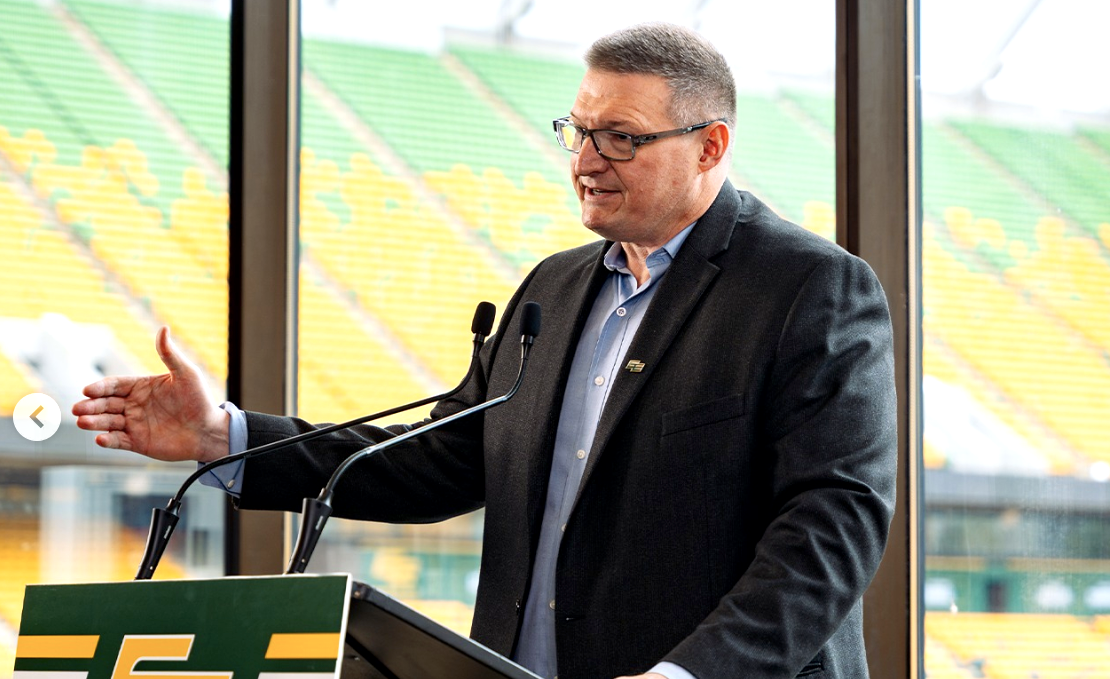
The Edmonton Elks appear to be on the upswing after enduring the darkest chapter in franchise history, so much so that team president and CEO Chris Morris believes the team can be profitable in the relatively near future.
“Last year was our first year. Within five years, I would expect that we’re profitable — if not before that. I think that year three and four is where we have to start looking at where that would be a viability,” Morris told 3DownNation in a recent wide-ranging interview.
“I feel very strongly that this place can be not just profitable, but very profitable within a three-to-five-year window. The first year (2025), we knew … we were going to have to sort of rally and do the best we can and start turning some minds and hearts. This next year (2026), we feel we have a nice base in that area. Now we’ve started to build our roster the way we want to — we start winning some games this year, and then next year (2027) is where we should start approaching where we’re getting closer, we’re somewhere in that range (of breaking even).
Get game analysis, stats, and more daily at 3pm
Here’s exactly what you’ll get.
- Canadian football's biggest stories
- Smart game analysis
- Every CFL transaction covered with exclusive insight
“Then, years four (2028) and five (2029) is where we should be looking to be profitable again. We have a huge stadium here. We have lots of seats here. … They have the wrong guy here if he’s sitting here telling you, ‘We don’t care about being profitable.’ There’s a whole bunch of pieces to building it and you have to build it right, but if you build it right in this city, you should be a profitable sports franchise, especially with football and especially with this facility.”
The 57-year-old revealed that the Elks lost around two-thirds of their season ticket base over the last decade, falling from over 20,000 to 7,000. Morris cited a “catastrophic series of events” as the cause of the collapse, including the COVID-19 pandemic, a record-setting 22-game home losing skid, and what he termed the “shocking, alarming, and disrespectful” manner in which the team changed its name.
Edmonton has missed the playoffs in six of the last seven CFL seasons, including each of the last five. For longtime fans of the team, this is an unthinkable failure. The club made 34 consecutive postseason appearances from 1972 to 2005, winning 10 Grey Cups during that time. Morris played along the offensive line for 14 of those seasons. He won three Grey Cup rings and never missed the playoffs.
“When you’re that bad, it takes time to regain credibility. You start off by building the foundational pieces, doing the right things and doing business the right way, but the reality is now we gotta start showing on the field,” said Morris. “We feel very good about heading into this next season and I think a lot of our fan base are starting to see that, but the reality is some of them are going, ‘I gotta wait and see what’s going to happen here.'”
“Close to 90 percent of the people who come in here who fill out surveys around their game-day experience are not just happy, they’re over-the-moon happy with the game-day experience. There’s a lot of positives going on … but it’s like perfume on a pig if you’re not winning games.”
Edmonton was once the CFL’s financial stalwart, consistently drawing crowds between 30,000 and 40,000 and posting annual profits of up to $6 million.
In the rare instances that the team lost money, there were always mitigating factors. Edmonton reported a $2.3 million loss in 2010 but paid $7.5 million toward the construction of the Commonwealth Community Recreation Centre, $1.3 million for new turf at Commonwealth Stadium, and bought out the contracts of then-head coach Richie Hall and then-general manager Danny Maciocia.
After the last few years, it’s hard to envision the Elks consistently getting back to crowds of that size. On paper, CFL attendance has dropped 7.5 percent league-wide since 2015, though a significant portion of that decline can be attributed to the collapse in Edmonton. If the Elks are removed from the dataset, CFL attendance has fallen only 1.9 percent over the last 10 seasons.
This raises the question: what kind of attendance do the Elks need in order to be profitable? The answer is lower than what one might expect.
“20,000 would be close (to making us profitable). At 20,000, depending on what your partnership is, depending on your merchandise, what your other streams of revenue are, you could be close. 22,000 to 25,000 is where you’re like, ‘OK, now we’re making money, now we’re going to be a profitable organization,'” said Morris.
“Averaging 25,000 if the team’s winning? I don’t think that’s something that’s beyond belief even in the next couple of years, but there’s no amount of fairy dust that I can spread around here if we start off 0-7 again. It just doesn’t matter, you have to be good. You have to have a good football product.”
In addition to dwindling crowds, it’s clear the Elks suffered similar losses in the area of corporate sponsorship. Shortly after he was hired following the 2024 season, Morris took it upon himself to try to reconnect the team with the local business community. He was met with significant pushback and skepticism.
“I had a meeting with several key prominent business owners and movers and shakers in the city when I first got here, and they were all just so angry about different things that had been done from a business standpoint and from a relationship standpoint,” said Morris.
“Sitting in that room listening to all the things, all I could really say was ‘Look, it’s gonna be different.’ You could tell by the looks on their faces, like, ‘OK, there’s been a bunch of presidents through here saying all that sort of stuff,’ but I think over the last year, I’ve become really good friends with several of them and it’s been meeting after meeting and connection after connection, and now several of them are so invested with us right now.”
Morris indicated there’s an upcoming gathering of close to 100 prominent local business owners scheduled to take place at the home of Grant Fedoruk, the owner and president of Leading Edge Physiotherapy. Entry is contingent upon interest in some form of partnership with the team.
For what it’s worth, Fedoruk’s biography on Instagram describes him as an Oilers and Cowboys fan. The Elks, apparently, didn’t make the cut.
“These are people who were so disappointed with the way we were doing things that they just didn’t want to be connected. For me, I can’t as one person stand on top of a building here in Edmonton and yell out, ‘The Edmonton Elks are going to be a great organization! We’re going to be awesome, character, integrity, all these things!’ and have people listen,” said Morris.
“I have to touch as many people as possible that have prominent and influential roles and get them to help me, and have them be out in the community saying, ‘Hey, I talked to Chris and these are the things they’re doing. This is how this business is gonna run moving forward, and the Thompson family is committed to this community.’ (We need to) have them go out and be market multipliers saying, ‘Look, this is why it’s good to come back and be part of this thing.’ I think we’re well down the road on that. I think we’ve got a lot of really good things going on here right now.”
Morris said the team has retained over 95 percent of its season ticket holders from last season, which was a priority given how the base had dwindled. With so many renewals secured, the team is now making a push to garner new season ticket holders ahead of the 2026 season.
“We’re way ahead on season tickets (relative to last year). We’re way ahead on partnerships. There’s a lot of positive vibes in the city right now about how we’re doing things,” said Morris. “We’re getting a bunch more (season ticket holders) in the hopper here. It’s going to be a process, but we’re making huge traction and huge headway this year.”
Powered by RedCircle
The Elks were publicly owned from their inception in 1949 until 2024, when lifelong fan and local construction magnate Larry Thompson became the team’s first private owner. A little over a year after the purchase was announced, Thompson died after suffering severe complications following surgery. He was 65.
Deb Thompson, Larry’s wife, released a statement following his death expressing the family’s enduring commitment to supporting the team. According to Morris, nothing has since changed.
“Deb is very, very committed to making sure that this goes forward. I think she loves the community and she loves what it does for the community, but she also has that sense of, ‘I know how important this was to Larry.’ I think that’s important to her because it was so important to Larry. She loves the sport, and her kids as well. They are fully committed to making sure this happens,” said Morris.
“That’s what it should be. It should be all of us together with the same sort of vision for how this looks like and building it out together, and I think we’re well on our way.”
The Thompson family is also involved in the revitalization of nearby Clarke Stadium. The Elks will play their home preseason game there in May while Commonwealth Stadium plays host to the Canadian Men’s National Team. Morris indicated there are plans for the venue to be domed and serve as a high-performance centre and community outreach hub, where kids from the local community will be able to visit Elks players every day.
“The Thompson family vision is to build out this section of Edmonton and to make sure that it’s taken care of and to make sure that the kids here and the families here have opportunities,” said Morris. “The Clarke revitalization is part of it and the family is very, very motivated and excited about what we can do to have an impact on the surrounding community.”
One could argue that Commonwealth Stadium is an obstacle to the team’s future success. Built in 1978, the venue is far larger than necessary by modern Canadian sports standards. Empty seats are bad for generating an engaging atmosphere, which is key to attracting fans.
Though a new stadium is badly needed in Calgary, Morris doesn’t believe the same is true for Edmonton. Instead, he would like to see the venue receive upgrades to modernize its amenities.
Two years ago, mock-ups of a refurbished Commonwealth Stadium began circulating online. The images depicted expanded concourses, renovated washrooms and concession areas, and large windows surrounding the venue’s exterior in place of its existing green panels.
At the time, the City of Edmonton told 3DownNation that the proposed upgrades would cost $250 million and there was no funding of any kind in place. It’s unclear if any of these upgrades will ever be executed, though new turf is currently being installed at the venue at the expense of the city.
“I think there needs to be some upgrades for sure, and I think if there’s gonna be a new stadium down in Calgary, usually the provincial government would look at a way to sort of go, ‘OK, we gotta take care of both sides.’ We do need some significant upgrades here. The city does a great job of maintaining what we have, but it’s older,” said Morris.
“The 30,000 lower deck is good. There’s lots of things we can do in the upper deck to build premium seating and to build different products for seating where it’s not necessarily always going to be like, ‘OK, if we don’t have 55,000 people here, it looks empty.’ I think that the biggest things are just the amenities, like the concessions and all those different things just need to be upgraded a little bit. I think that’s a part of what the city would do.”
It remains to be seen if the efforts of Morris and his staff will pay off. The Elks didn’t become a disaster overnight, and it’ll take lots of time for the team to reach the heights from which they fell.
Regardless, Morris seems optimistic about the team’s future. With a new media rights deal in the works, the team should receive a boost to its coffers for 2027 regardless of their attendance.
It’s also easy to envision crowds starting to return to Commonwealth Stadium if the Elks prove they can make the playoffs. The team is coming off back-to-back 7-11 seasons, both of which featured miserable starts.
In 2024, Edmonton began the year 0-7, then went 7-4 over its remaining games. A similar story played out in 2025 when the club started 1-6, then went 6-3 over its next nine games.
“I think this club, even though it’s a private owner now as opposed to being a community-driven club, we’re about serving the community of Edmonton. We’re about bringing value to our community — value in having a good football product that people can be proud of, having a huge charitable arm that serves the community directly. Whatever business interests are in the city, they should be able to say, ‘Let’s partner with the Edmonton Elks,'” said Morris.
“How can we make an impact on kids? How can we make an impact on the community? … We want to be a contributor here as opposed to standing here and being like, ‘We’re the Edmonton Elks, what can the city do for us?’ I think that is a massive shift and I think that, for me, the Thompson family has embodied those sorts of beliefs as long as they’ve been around. I think one of the reasons that the job was such a great fit was that that’s what I believe in. I believe that this whole thing, everything about the Edmonton Elks, should be about serving the City of Edmonton, the people here, the community here, the kids here, the families here, and I think we’re getting people in the building who believe in that.”
“I’m extremely confident (we can fill a good portion of Commonwealth Stadium again someday). The City of Edmonton loves football, the City of Edmonton loves to be connected, and they love to rally around something that’s important to them.”


B.C. Lions
3DownNation CFL power rankings:
Calgary Stampeders
Calgary Stampeders release Montréal product Kaylyn St-Cyr, nine others
Saskatchewan Roughriders
Jack Coan, Trevor Harris compete to outwork each other with Saskatchewan Roughriders
Saskatchewan Roughriders
Saskatchewan Roughriders sign undrafted Canadian DB Trae Tomlinson
Winnipeg Blue Bombers
Mike O’Shea defends Willie Jefferson’s declining sack numbers

Hamilton Tiger-Cats
Matthew Shiltz inks one-day contract to retire with Hamilton Tiger-Cats
Toronto Argonauts
Toronto Argonauts cut incumbent starter Spencer Brown, nine others
Toronto Argonauts
Toronto Argonauts sign Alex Teubner after release from B.C.

Ottawa Redblacks
Ottawa Sooners building star-studded CFL coaching staff in CJFL
Montreal Alouettes
Veteran CFL quarterback Dustin Crum chose Montreal Alouettes over B.C. Lions
Winnipeg Blue Bombers
The CFL’s highest-paid running backs and fullbacks in 2026
B.C. Lions
The CFL’s highest-paid receivers in 2026

Edmonton Elks
The CFL’s highest-paid offensive linemen in 2026
Winnipeg Blue Bombers
Five position battles to watch in Winnipeg Blue Bombers training camp
Toronto Argonauts
Syracuse, Wake Forest to play at BMO Field in Toronto in 2027
B.C. Lions
The CFL’s 30 highest-paid players for 2026
Edmonton Elks
The CFL’s highest-paid defensive backs in 2026
Calgary Stampeders
Vernon Adams Jr. signs contract extension with Calgary Stampeders

Winnipeg Blue Bombers
CFL rookie, training camp vet Taylor Elgersma ready to battle for Winnipeg Blue Bombers
Toronto Argonauts
Toronto Argonauts release QB Max Duggan
Ottawa Redblacks
Ottawa Redblacks 2026 CFL training camp primer (offence)

Winnipeg Blue Bombers
Brady Oliveira wants to play 10 CFL seasons, retire as a Winnipeg Blue Bomber
Saskatchewan Roughriders
Position battles to watch in Saskatchewan Roughriders 2026 CFL training camp
Ottawa Redblacks
The CFL’s highest-paid linebackers in 2026
Saskatchewan Roughriders
Saskatchewan Roughriders sign Regina native Ryder Varga
Toronto Argonauts
Toronto Argonauts unveil WWE, ‘loonie dog’ game themes for 2026
From 3DownNation Reporters