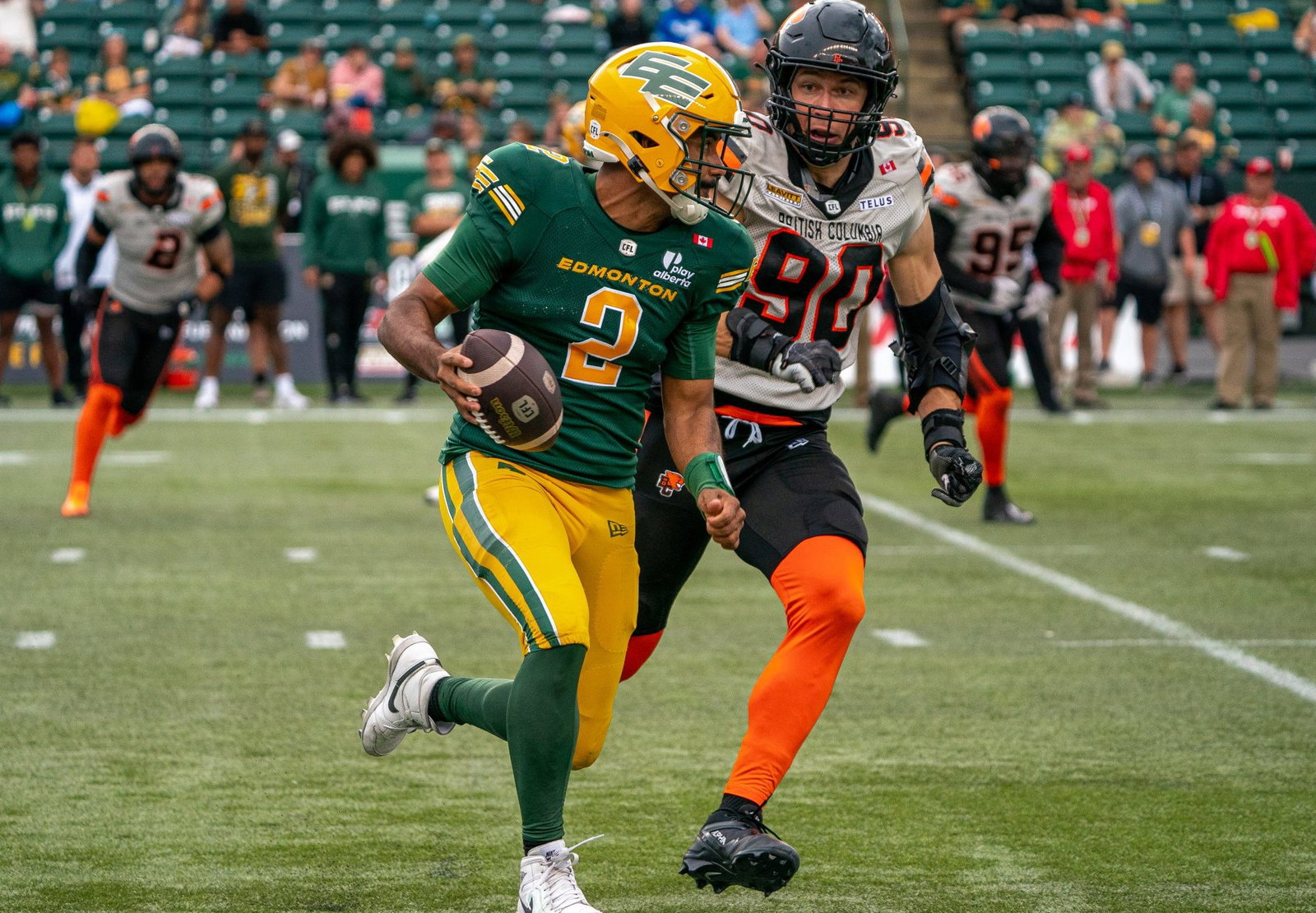
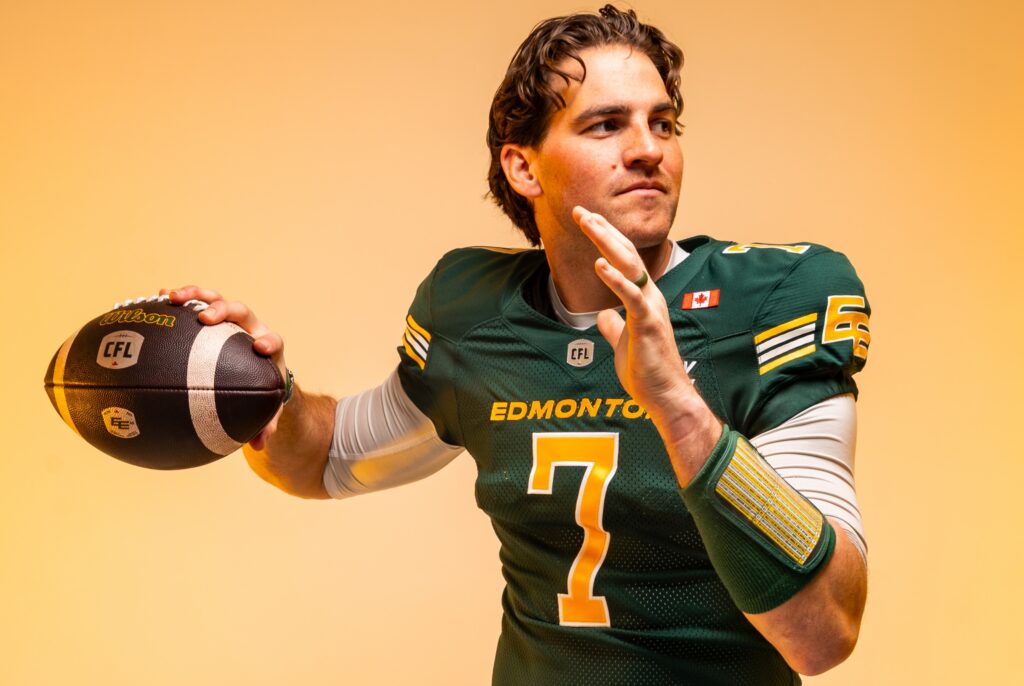
There’s a lot more at stake in the Edmonton Elks’ Tre Ford experiment than just revival for a stumbling franchise.
The CFL once proudly separated itself from the NFL in ways that made Canadians brag about our game being superior. For generations, the three-down game produced matches full of high scoring and big plays that Americans could only dream of. American college coaches were a common sight at Canadian stadiums in the 1990s, spending the end of their offseason summer nights north of the border watching one of their graduates and studying the Canadian game.
As a matter of fact, one does not need to look all that deep into the YouTubeosphere (yes, I invented that word) to see the Michael Jordan-esque moves of a young athlete who brought fans out of their seats and drew crowds of more than 50,000 in a challenged CFL city.
It happened in 1991, and I’m not talking about Rocket Ismail. It could be argued that the CFL’s most Hollywood team ever was actually Doug Flutie and the B.C. Lions.
Ford does not yet belong in the same sentence as Doug Flutie, but hear me out.
Flutie set the all-time single-season pro football passing record, the Leos scored 36.7 points a game, and electrified the West Coast in ways it had not been jolted before or since. The Lions averaged more than 40,000 fans per game that year, drawing north of 50,000 twice, numbers the Elks’ current owner, Larry Thompson, would do just about anything for.
That success happened largely on the back of Doug Flutie making eye-popping broken plays. The type of plays we are reminded of when watching Tre Ford quarterback the Elks today.
And it all came oh-so close to never happening at all. In fact, just the year before, Flutie was struggling to prove he should even be the starter. He was, in many ways, at age 27, right where Tre Ford is today at age 27.
Labelled as an athlete too small to play quarterback, Flutie had found himself stuck in a crowded quarterback room that included the likes of lovable career backup Rickey Foggie, washed-up has-been Joe Paopao, and the never-would-be Major Harris.
All those players were professional-calibre quarterbacks, but did not measure up to the greatness that would become of Doug Flutie. No CFL player ever has. Flutie was out of their league, and yet he struggled as badly as the rest of his teammates did in limping to a 2-7-1 record. The team cleaned house just after Labour Day, firing head coach Lary Kuharich and general manager Joe Kapp.
Tre Ford’s path has been a lot different than Flutie’s, but the theme of coaches not figuring out a proper system for him might sound familiar. We have watched offensive coordinators Stephen McAdoo, then Jarious Jackson to a lesser extent, and now Jordan Maksymic struggle to fit this spectacular athlete into their plans.
Faced with a similar crisis to what the Elks are enduring right now, the owner of the 1990 B.C. Lions, infamous playboy Murray Pezim, courted a CFL lifer to clean up the awful mess.
Most CFL historians think of Bob O’Billovich, who just celebrated his 85th birthday, as the man who led the Toronto Argonauts to their first Grey Cup win in 31 years. In reality, his best work might have been rescuing the greatest CFL quarterback of all-time from the train wreck that was Lary Kuharich’s offence in BC.
Results were still slow coming, but the Lions’ 4-3 finish to narrowly miss the playoffs showed flashes of what was to come. It also provides a glimmer of hope for the Tre Ford watchers hoping the kid makes it.
“Doug wasn’t playing in the proper type of offence that would let him excel for his abilities,” O’Billovich told Last Word on Sports back in 2017. “When you work with your individual quarterbacks, you determine what you think are the best kinds of things that he can do, and then you put that into your offence to allow him to be the best player that he can be.”
“Prior to me getting to B.C., they were trying to use Doug as a drop-back passer, and that wasn’t Doug Flutie’s strength as quarterback. His ability to get outside the pocket and sprint out where he could make himself dangerous, and if things broke down, he could be the athlete that he was. The next year, we implemented an offence that was better suited for him, and he took it and ran. He had an outstanding year!”
Does any of that sound familiar to the predicament faced by the Edmonton Elks today? The views emerging from some expert Canadian football coaches appear to be mixed.
Mike Kelly didn’t have the greatest success in head coaching the Winnipeg Blue Bombers for one season, but he did oversee much of Matt Dunigan’s greatest individual successes as an offensive coordinator, including the record 713-yard performance in ‘94 that still stands today.
Kelly had this to say when asked via social media about the state of today’s CFL offences, and whether or not he would handle Tre Ford any differently than Edmonton’s coaching staff.
“Today’s game is bastardized American nickel football,” Kelly said. “I believe Tre’s skill sets would be better served in the half-roll and full roll-out game with more play action and boots off the run game. I’m a fossil now, so they can use the schemes they know, but I’m not a fan of it, and the premise of any scheme should be based on the physical attributes of the players.”
I also reached out to John Behie, Ford’s position coach at the University of Waterloo, where he made his name as the Hec Crighton Trophy winner. Living civilian life now, Behie wouldn’t offer a critique on the current state of the Elks’ offence, but did point to a few things from his successful partnership with Edmonton’s quarterback.
“One of the things that we kept saying was we did not ever want to, for lack of a better term, put clamps on his athleticism. We wanted to build something around him that showcased his skills, and that includes his speed and his running ability,” Behie said.
“We had said that if we’re not calling some designed runs, we’re doing him a disservice. But then the other thing was once or twice a game, there might be times where other quarterbacks might have hung in the pocket and waited for something to open up, but we were okay with his decision to maybe pull it down and run to try to make something. We call it that secondary play. We were okay with that. We embraced that because we knew that it would work out in our favour more times than not. A bit of a change of mindset because you do lose a little bit of control, and coaches love control, but we were okay with living like that.”
Like Doug Flutie in 1990, Tre Ford is stuck in an offence many say is not compatible with his athletic abilities. George Cortez, one of the most decorated offensive coaches in CFL history, has spent a lifetime having his own offensive schemes critiqued by writers, but swears he never paid attention to any of it. He cautions all of us about second-guessing the Edmonton coaching staff for their handling of such a unique weapon.
“The coaches they currently have know more about him (than anyone else), especially in this case, because he hasn’t played anywhere else. It’s not like he’s Vernon Adams Jr., who has been with five different teams,” Cortez said.
Once Doug Flutie’s offensive line coach with the Stampeders, Cortez was supposed to coach in Calgary for a last dance in 2020 before the coronavirus scuttled that swan song. He remembers grading Tre Ford as a talented athlete in his draft year, but wasn’t sold on him as a pro quarterback yet.
“When (Ford) gets out in the open field, he’s really dangerous. There’s not any doubt about that. I would bet they don’t mind that he runs, but would like for him to be judicious about it because the more you run, the more likely you are to get hurt.”
Many would argue the NFL has caught up to the CFL in excitement. The Elks’ young signal-caller, if he ever figures it out, just might be the response three-down loyalists have been waiting for.
The jury is still out on Edmonton’s quarterback, and his starting status is currently in jeopardy. More time is needed for everyone to deliberate on his future. But he just might be worth the investment for the Elks, and more importantly, the CFL, to gamble on third-and-long with a system that maximizes what only he can do.


B.C. Lions
3DownNation CFL power rankings:
Calgary Stampeders
Calgary Stampeders release Montréal product Kaylyn St-Cyr, nine others
Saskatchewan Roughriders
Jack Coan, Trevor Harris compete to outwork each other with Saskatchewan Roughriders
Saskatchewan Roughriders
Saskatchewan Roughriders sign undrafted Canadian DB Trae Tomlinson
Winnipeg Blue Bombers
Mike O’Shea defends Willie Jefferson’s declining sack numbers

Hamilton Tiger-Cats
Matthew Shiltz inks one-day contract to retire with Hamilton Tiger-Cats
Toronto Argonauts
Toronto Argonauts cut incumbent starter Spencer Brown, nine others
Toronto Argonauts
Toronto Argonauts sign Alex Teubner after release from B.C.

Ottawa Redblacks
Ottawa Sooners building star-studded CFL coaching staff in CJFL
Montreal Alouettes
Veteran CFL quarterback Dustin Crum chose Montreal Alouettes over B.C. Lions
Winnipeg Blue Bombers
The CFL’s highest-paid running backs and fullbacks in 2026
B.C. Lions
The CFL’s highest-paid receivers in 2026
Edmonton Elks
The CFL’s highest-paid offensive linemen in 2026
Winnipeg Blue Bombers
Five position battles to watch in Winnipeg Blue Bombers training camp
Toronto Argonauts
Syracuse, Wake Forest to play at BMO Field in Toronto in 2027
B.C. Lions
The CFL’s 30 highest-paid players for 2026
Edmonton Elks
The CFL’s highest-paid defensive backs in 2026
Calgary Stampeders
Vernon Adams Jr. signs contract extension with Calgary Stampeders
Winnipeg Blue Bombers
CFL rookie, training camp vet Taylor Elgersma ready to battle for Winnipeg Blue Bombers
Toronto Argonauts
Toronto Argonauts release QB Max Duggan
Ottawa Redblacks
Ottawa Redblacks 2026 CFL training camp primer (offence)
Winnipeg Blue Bombers
Brady Oliveira wants to play 10 CFL seasons, retire as a Winnipeg Blue Bomber
Saskatchewan Roughriders
Position battles to watch in Saskatchewan Roughriders 2026 CFL training camp
Ottawa Redblacks
The CFL’s highest-paid linebackers in 2026
Saskatchewan Roughriders
Saskatchewan Roughriders sign Regina native Ryder Varga
Toronto Argonauts
Toronto Argonauts unveil WWE, ‘loonie dog’ game themes for 2026
From 3DownNation Reporters