Micah Johnson’s decision to retire and join the Saskatchewan Roughriders’ coaching staff was dichotomous in nature: sudden and unexpected, yet somehow a decade in the making.
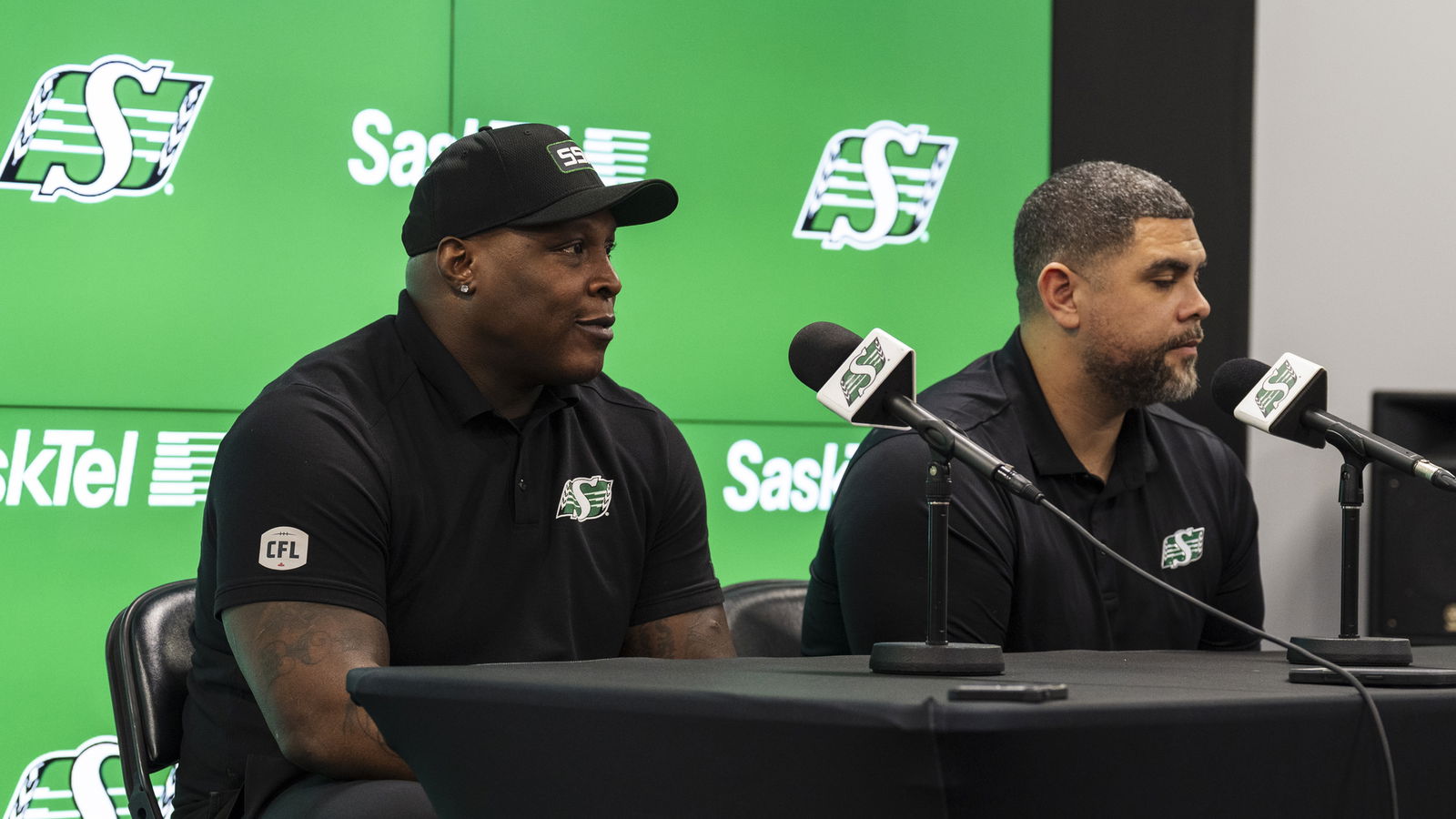
“I’ve known I’ve wanted to coach for some years now. It’s been conversations I’ve had with (head coach Corey) Mace for years, even before he came here,” Johnson told the media at his transitional press conference.
“Conversations I had with (general manager Jeremy O’Day), with Kyle (Carson), a lot of different people around the organization, feeling like I want to coach after I’m done playing. To get this opportunity is amazing, and I don’t take it for granted, not one bit. I’m just blessed, and I’m very thankful.”
Johnson called it a career on Monday after 12 seasons in the CFL, having spent five of his past six years in Saskatchewan. The seven-time all-star exits on his own terms at the top of his game, having earned All-CFL honours in 2025 at the age of 37 and helped the Riders capture the fifth Grey Cup in franchise history.
In the aftermath of that championship, those who spoke to Johnson encountered a player who was adamant that he had more gas left in the tank. That opinion hasn’t changed, but when the opportunity to become the Riders’ defensive line coach arose, he was forced to think in the long term.
“When I left the field last, I didn’t have the intention that it was gonna be my last time playing. For me, it was just the opportunity. I came to this decision shortly; it hasn’t been something that was long thought out,” Johnson explained.
“You keep playing, and you see guys your age coaching you, coaching half the guys you’re playing with — you’re seeing guys your age move on. I was starting to get that feeling like I was getting behind in my next phase in my life by still hanging on to the football. That was a heavy factor for me.”
Setting the stage for the decision were those previous conversations with Mace, the man offering the job in light of predecessor Phillip Daniels’ departure for Ottawa. Before they were head coach and player, the two men were teammates in Johnson’s early years with the Stampeders, and he witnessed firsthand as Mace made his own move directly from the defensive line onto Calgary’s coaching staff in 2016.
From that point on, discussions about how to transition into coaching were a normal occurrence, regardless of what teams the pair found themselves on.
“Just casual conversations during our time dating back to the Calgary days. I always try to have guys think about post-playing, and, quite naturally, people would ask about the coaching,” Mace recalled. “For me, I just told them it was luck — I got offered a job, and you take it. But talking about different scenarios of how that path might go for certain players who want to get into coaching where luck is not involved, just different avenues and how you get your foot in the door and prove yourself.”
“Ironically, I’m sure we talked about it as sometimes things get placed in front of you and you’ve got to make a decision. And certainly, this was almost that deal. But I don’t want to take anything away; there was a full process in going to get it done, and (Johnson) got the job, man. He listened good, I guess, which was great.”
Mace’s transition from co-worker to coach shows just how much success can be found by following that path, as his unique ability to relate to players has been widely credited as a factor in the Riders’ improvement during his tenure. However, the move will not be without its challenges for Johnson, who will now have to be in charge of the men with whom he was brothers-in-arms less than two months ago.
“Luckily, not even just myself, there are a few coaches on staff who were fortunate enough to have that happen for them in their coaching career that he’ll be able to lean on for some of the nuances of that,” Mace noted.
“It’s hard. There is a line that you kind of have to draw in the sand, and just having those guys understand that he’s got a job to do. Having those relationships and those guys having the respect for understanding that I don’t think will be any issue. Certainly, playing, as long as Micah has played, and you see his family here, he’s got a lot of responsibility outside of the lockerroom, too. I think the transition is going to be a little bit easier than it was for me. I think I was freshly married, maybe — I don’t know, I wasn’t figuring out anything at that point. He’s mature, he understands, and I think the guys will respect his position as a coach.”
Johnson isn’t any more daunted by this next chapter than he was by offensive linemen throughout his playing career — that is to say, not at all. As a veteran, he already viewed himself as an extra coach on the field and was never shy about taking younger guys aside for instruction.
That should dovetail nicely into his next phase, for which he is extremely grateful.
“It means everything to me,” Johnson said. “When you’re around people for years, at this point, you hope that you’ve developed some relationships in the building that go beyond ball. You hope that people understand your character, understand what you stand for, to be able to give you this opportunity. To even have been able to sit in the room with JO and Mace, and actually interview, that was amazing. It’s one of those things you hope for.”