3Down
‘Hands across the border’: the day the Grey Cup came to Fargo, North Dakota

A short drive directly south of Winnipeg, North Dakota has long been a destination state for Manitobans wanting to relax, shop for a weekend, and bring home cheap-priced alcohol.
But U.S. tariffs and comments from President Donald Trump that Canada become the “51st state” have caused many Manitobans to stay on their side of the 49th parallel.
71 years ago there was no such tension, just plenty of goodwill.
That year, an invitation from citizens and business owners in Fargo, N.D. was extended to all Manitobans to come to the city and watch television — specifically, a live broadcast of the 1954 Grey Cup game.
It was an idea first dealt out around a bridge table in Winnipeg.
During his numerous travels to the city for meetings, Al Joelson, owner of Sid’s Tavern in Fargo, experienced first-hand the friendliness of Manitobans.
During one trip in the summer of 1954, Joelson was playing bridge when Winnipeg Contract Bridge Club members Dave Richman and Mel Stover flipped the trump card and suggested that a Grey Cup viewing party would drive Manitobans to Fargo to watch the game.
To understand why the pair would spring the idea — it sounds odd now — requires a look back at the Canadian television landscape at the time.
***
In the early 1950s, television in Canada was in its infancy. The CBC had radio stations coast to coast, but only two TV stations in Toronto and Montreal that began transmitting in 1952.
Since 1928, Canadians had been listening to the Grey Cup game live on radio. It wasn’t until Nov. 29, 1952 that the football championship was, for the first time, televised live.
That Saturday afternoon match between the Toronto Argonauts and Edmonton Eskimos was played at Varsity Stadium in Toronto, but only those living in or around Toronto could watch it if they had a TV set. A kinescope film of the telecast was shown the next day in Montreal.

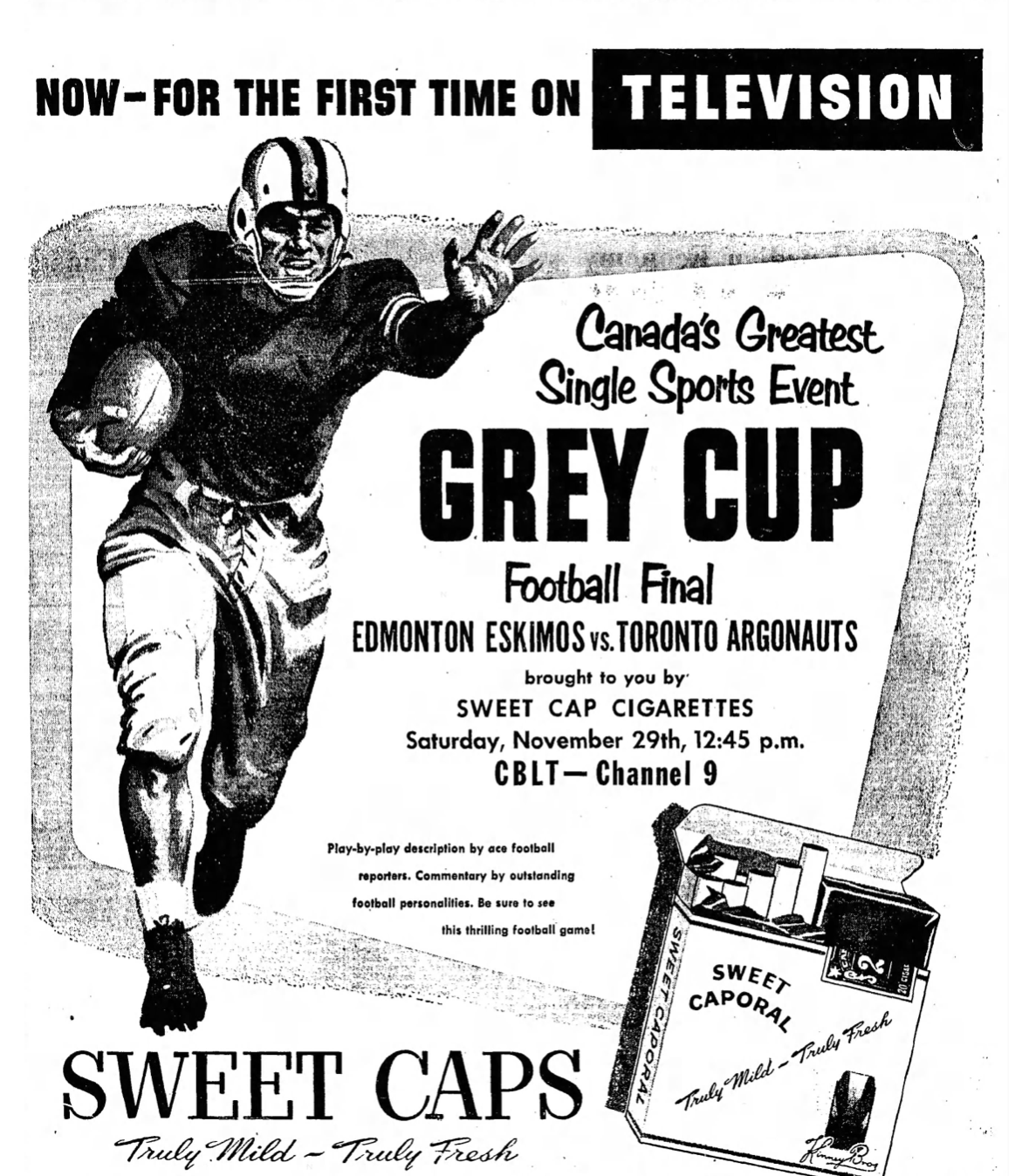
Photo: Toronto Star
The following year, the CBC again televised the Grey Cup game live to its stations in Toronto, Montreal, and now Ottawa.
It was not until May of 1954 that a CBC station was up and running in Winnipeg with stations added in the following months in Regina, Calgary, and Edmonton.
However, the CBC was only capable of bringing the Grey Cup game live to viewers in Eastern Canada. Fans in the West would have to wait a day to see the game on their own TV sets. (The Grey Cup wasn’t televised live across the country until 1957).
Because the Winnipeg Blue Bombers and Eskimos were the top teams in the west in 1954, the CBC devised a plan to bring viewers in those cities a same-day telecast of the Grey Cup game.
With the assistance of the Royal Canadian Air Force, film of the Grey Cup TV broadcast would be flown on a T-33 Silver Star jet aircraft to Winnipeg from Toronto just hours after the actual end of the game. The flight would arrive at 8:00 p.m. local time and the game would air two hours later.
There was another jet aircraft on the tarmac in Winnipeg waiting to fly a second film to Edmonton that would also air that night. CBC viewers in Regina and Calgary had to wait until Sunday.
The CBC’s plan wouldn’t satisfy Richman and Stover.
***
During that Winnipeg bridge tournament, the pair tossed around the idea to Joelson that thousands of Manitobans would eagerly make their way to Fargo to watch the Grey Cup live rather than wait hours at home to see what they already heard on the radio.
Joelson was described in one Winnipeg newspaper as a “cigar-smoking, rotund extrovert.” His only comment to that was that he hadn’t smoked cigars in years.
What made Richman and Stover’s suggestion remotely possible was that during the 1954 season, Canadian football games featuring the “Big Four” eastern clubs of the Montreal Alouettes, Ottawa Rough Riders, Argonauts, and Hamilton Tiger-Cats were being televised live in the United States on NBC every Saturday.

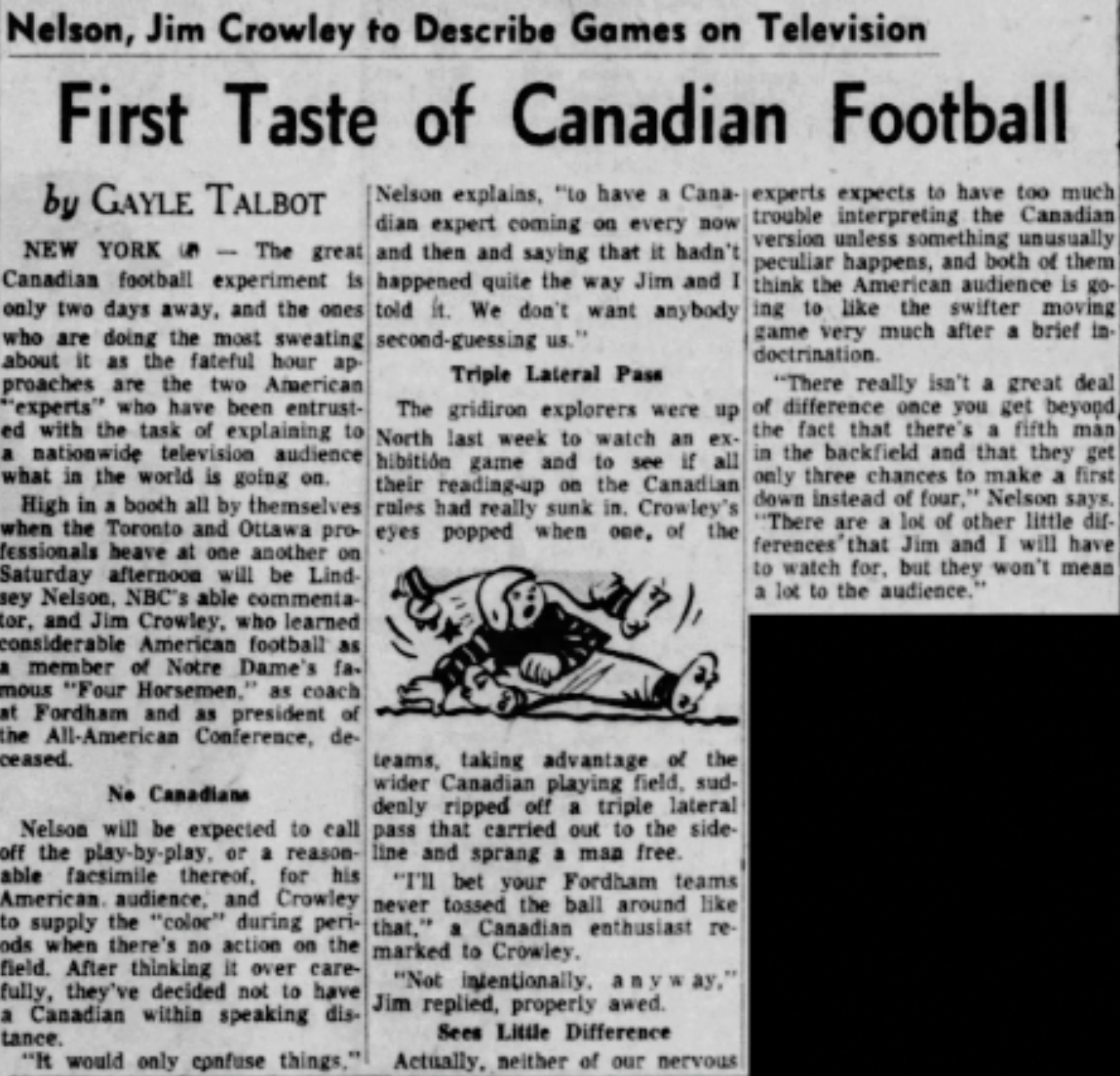
Photo: Various U.S. papers
It wasn’t that NBC executives loved Canadian football. They were upset after being outbid for U.S. college football television rights and hoped to take viewers away from ABC and the former DuMont Network.
NBC even employed its own broadcasting team for its Canadian coverage, with Lindsey Nelson and Jim Crowley — one of Notre Dame’s fabled “four horsemen” — handling the play-by-play and analyst duties.
NBC was encouraged by early interest in three-down football, boasting that 20 million Americans watched its first Big Four telecast when Toronto defeated Ottawa 13-6.
By the 1954 Grey Cup, NBC had a network of 70 cities that would broadcast the game. CBC had only 22 stations in Eastern Canada that could broadcast the Grey Cup live.
According to a newspaper account of events in the Fargo Forum, Joelson didn’t truly believe Manitobans would make the journey but changed his mind when he started getting long-distance calls from Winnipeggers hoping the game would be shown live in Fargo.
So Joelson went to work rounding up support from Fargo’s mayor, hotels, bars, and local retailers for what he viewed was a goodwill gesture and opportunity for Fargoans to thank Canadians for the kindness they always shown Americans.
He won them over.
Joelson still needed the only TV station in Fargo, WDAY-TV, to agree. With no local competition, WDAY could choose to broadcast any program from existing four American networks.
On that particular U.S. Thanksgiving Day Saturday, the biggest football game was the traditional Army-Navy clash. WDAY brass was convinced the Grey Cup game would be more beneficial to their community, so they punted aside college football for a slice of Canadiana.
It was the right play call.
***
“Welcome Winnipegers” (sic) signs were printed and placed all around Fargo, a city of 40,000 with the adjoining town of Moorhead, Minn. The initial goal was drawing 4,000 Manitobans to spend the weekend in the city, a target that seemed achievable, especially if the Blue Bombers were playing.
Northern Pacific Railway even agreed to add special compartment trains if demand warranted, with the train leaving Winnipeg on Friday morning and arriving in Fargo that evening. Passengers could even use train accommodations overnight with the entire round trip costing $27.50, the equivalent of around $320.00 today.

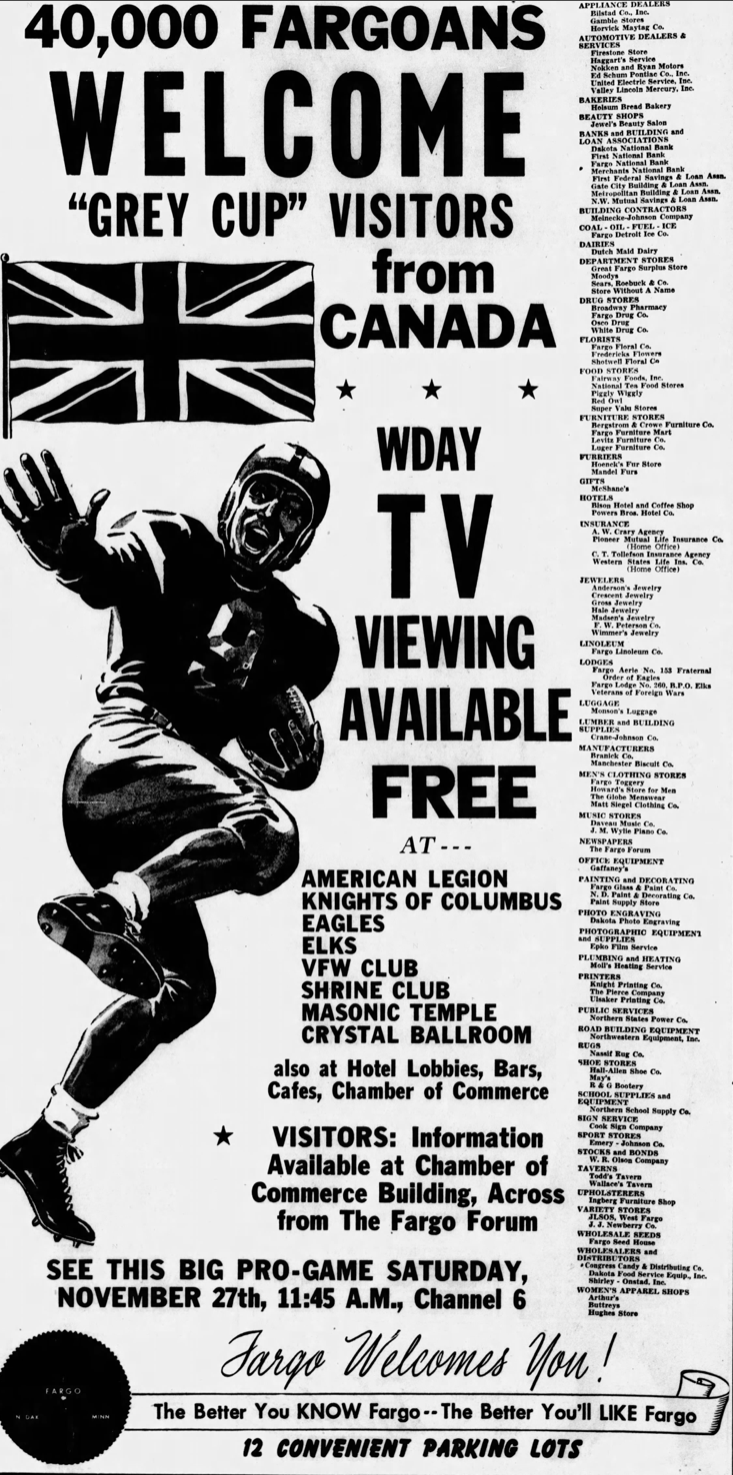
Photo courtesy: Fargo Forum
Meanwhile, Branch 141 Legion in Winnipeg arranged for charter buses to take all members to Fargo for $5.50 return. Most fans made the 359-kilometre trek by car.
The Eskimos somewhat spoiled the party by beating the Blue Bombers in the WIFU finals, setting up a Grey Cup game against the Alouettes. The matchup did little to sack the enthusiasm of Manitobans.
What did disrupt the weekend event was a blizzard that hit parts of Manitoba, North Dakota, and Minnesota the day before the big game. More than 15 centimetres of snow fell in Winnipeg, which, combined with wind and icy highway conditions, it made for a tense drive.
Yet there were few hotel cancellations and the U.S. Immigration Service reported that 1,042 people had crossed into North Dakota at Pembina and another 1,118 entered at Noyes, Minn.
There was a group of seven Manitobans who couldn’t make it to Fargo in time for Saturday’s noon CT kickoff, so they stopped in Hillsboro about an hour’s drive north of the city and were welcomed by residents and watched the game at a local furniture store.
A group of 40 Lions Club members set up their Grey Cup watch party at Fargo’s Graver Hotel, taking over the second floor.

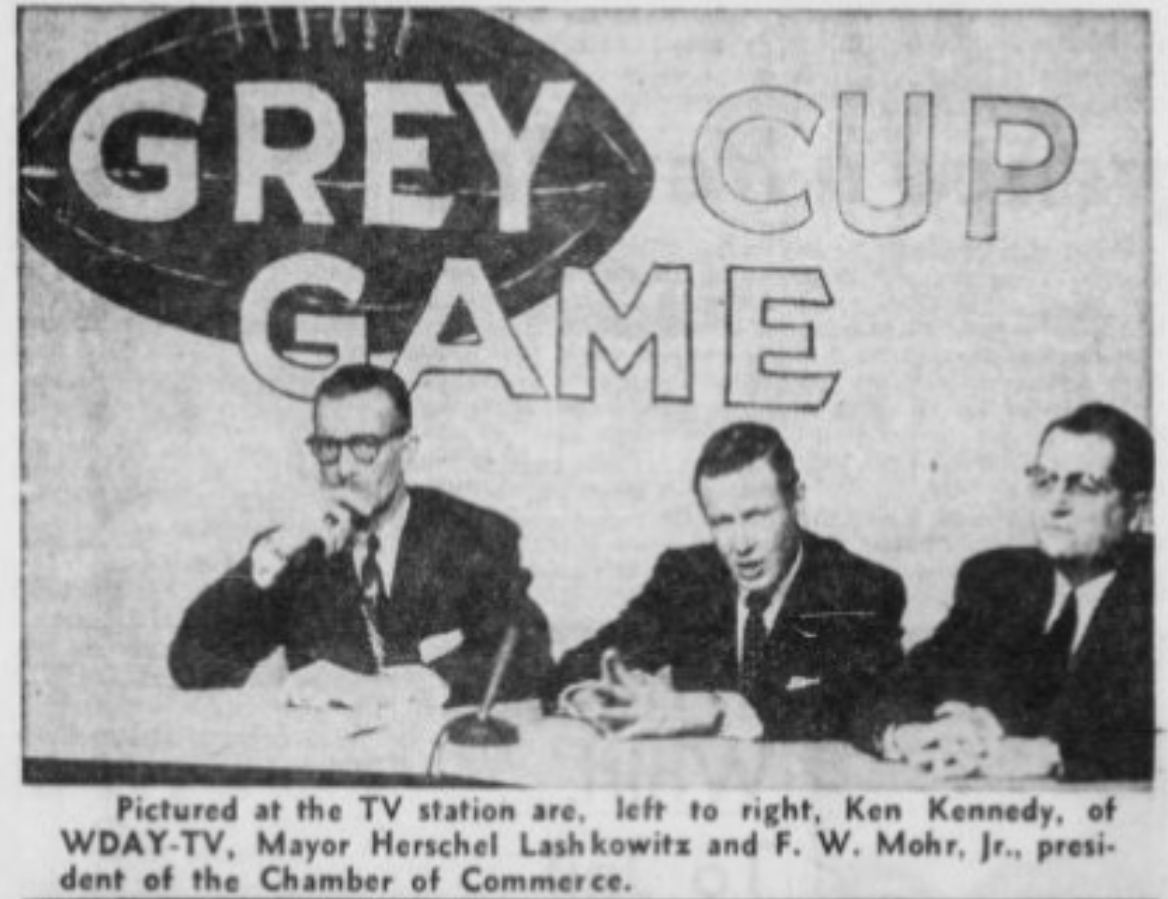
Photo courtesy: Winnipeg Tribune
WDAY-TV did more than just broadcast the Grey Cup, they were all in, producing a “Hands Across the Border” pre-game show featuring reporters from both Fargo and Winnipeg.
Best estimates pegged about 2,500 Canadian football fans successfully making the trip to Fargo for watch parties at hotels, bars, legions, and other spots. There were no admission charges and dances were held after the game.
Before and after the game there was even time for shopping.
Winnipeg Free Press columnist Gene Telpner noted that Fargo retail merchants reported a buying spree by Canadians.
“Appliance dealers said sales were exceptionally heavy and clothing merchants reported large sales to Canadians,” he wrote.
Taxi drivers told Telpner they had their biggest night since New Year’s Eve and found Winnipeggers to be “big tippers.”
The Eskimos were the team of choice for most fans and the western team prevailed in what was a thrilling Grey Cup. Instead of listening on radio, fans who made it to Fargo saw Edmonton’s Jackie Parker scoop up Chuck Hunsinger’s fumble and return it 85 yards for the game-tying touchdown. The convert gave Edmonton a 26-25 victory and the Grey Cup.
Back in Winnipeg, the storm delayed the arrival of the telecast’s kinescope film and the game didn’t air until the next day in both Winnipeg and Edmonton.
During the party, Fargo Mayor Herschel Lashkowitz deemed the Grey Cup weekend a success.
“I think this kind of an affair is an example for our two countries, for the hemisphere and even for the world,” he said. “An example of how nations can and should get along with each other.”
Words many on both sides of the border wish were still true today.